Thursday, September 8, 2011

Effective SEM - Use Negative Keywords Approapriately

Continuing on the theme of seven steps of effective SEM that I outlined in one of my previous posts, in this post I will discuss the fourth step (Use Negative Keywords Approapriately) in details. Note: All the examples used in this post are related to Google Adwords.


Being thoughtful about negative keywords is an important step in setting up effective search engine marketing campaigns. If you do not include the right negative keywords in your campaign, you will be wasting a lot of impressions resulting in significant increase of your advertising cost. For example, if you are an enterprise software provider and you do not want your ad to be shown to people searching for "free" software, you should use "free" as a negative keyword in your campaign.

Monday, August 22, 2011

Effective SEM - Optimize the Organization of Ad Groups, Ads, and Keywords

Continuing on the theme of seven steps of effective SEM that I outlined in one of my previous posts, in this post I will discuss the fourth step (Optimize the organization of Ad Groups, Ads, and Keywords) in details. Note: All the examples used in this post are related to Google Adwords.

How you organize your ad group, ad copy, and keywords have a great impact on how your ads perform. As I mentioned in my previous post, the other key ingradient to this is the relevant landing page. If you do not optimize the organization of your ad group and ad copy with the relevant keywords you end up with lower quality scores. The result: lower average position for your ad, paying more for your ad etc.

Thursday, August 18, 2011

Effective SEM - Improving Relevance of Your Ad Text

Continuing on the theme of seven steps of effective SEM that I outlined in one of my previous posts, in this post I will discuss the third step (improving relevance of your Ad text) in details. (Note: the examples used in this post are all related to Google Adwords)

Your ad copy is one of the most important vehicles to reach to your prospects. You need to make your ad copy enticing for the user to click on the link and look at your offer. Making the ad text very relevant to the search the user did and adding appropriate call to action increase the probability of someone clicking on the link. For example, by including one of the keywords in the ad text (preferably on the title), you make the ad very relevant to the search the user is doing.

Tuesday, August 16, 2011

Effective SEM - Using Approapriate Campaign Settings

Continuing on the theme of seven steps of effective SEM that I outlined in one of my previous posts, in this post I will  discuss the first step (Use Appropriate Campaign Settings) in details. (Note: the examples used in this post are all related to Google Adwords)

Structuring your campaigns appropriately is the first step in effective search engine marketing. Once you have decided on the number of campaigns you want to run, you need to be very thoughtful about the settings you want to use for your campaigns.  You could be wasting a lot of "impressions" unnecessarily if you are not using the right settings for your campaign.

Wednesday, August 3, 2011

Effective SEM - Keyword Evaluation

Cartoon credit Edouard Blais
In my last post before the summer hiatus :-) I talked about 7 steps for better search engine marketing. In this post I will talk in details about one of the tips mentioned in the post - continuing to use keywords effectively.

Keywords are undoubtably one of the most important artifacts for running effective SEM campaigns. It's, however, not sufficient to identify the right keywords and set them up in the campaigns as a one time deal. For your keywords to remain relevant, make sure that you evaluate the performance of your keywords on a regular basis and make adjustments as necessary. People might use new terms to search for your product over time - you need to potentially add those as keywords to your campaign. You want to revisit what search terms your competition might be using to drive traffic to their sites.

Here are some of the steps you want to consider taking to do periodic evaluations of your keywords (Note: my examples are based on Google Adwords):

Tuesday, April 5, 2011

7 Tips for Better Search Engine Marketing

Whether its for buying a car or a flight ticket, consumers have been using the internet  as research a media for a while now. Increasingly, in the B2B world, customers are showing up on-line to do a lot of their primary research. As such, effective on-ine marketing is becoming a must-have tool for a B2B marketer.

In this post I will provide some broad strokes on tips for running effective paid search campaigns. In future posts, I will write about each of these tips in more details individually.

Monday, March 21, 2011

Social Media Marketing - Remembering the Basics

Nothing is probably riding the hype cycle as much as social media these days.  By the majority of indicators social media is not a fad anymore.  It's revolutionizing the way we communicate and it's here to stay. Given all the buzz around it though how do you leverage it effectively as a B2B Marketer?

Just because social media is a new platform does not mean that "old" marketing principles do not apply any more. It's easy get swept by thinking "this time its different" (remember the "innovative" approaches of company valuations during the dot com days of late nineties?)

Here are a few principles to keep in mind when you are starting out with your social media campaings:

Wednesday, February 16, 2011

Hiring a Product Manager from Outside

Antibodies are special proteins used by the immune system in the human body to identify and combat foreign elements such as viruses and infections.

Scientists have found a subtype of rotifers, small freshwater invertebrates, which can capture and assimilate DNA from other organisms in the environment. “Researchers think this unusual capability of the organisms to copy and paste bits of foreign DNA may have helped this class of rotifers to exist for millions of years without resorting to sexual reproduction”. You can read about the NPR story here. 

No organization or groups of people probably reject the notion of hiring an outsider like antibodies do in human bodies. Likewise, few organizations have mastered the art of assimilating an outsider into their company and culture like a certain kind of rotifer do.

Most organizations fall somewhere in between.

Saturday, January 22, 2011

PEDAL Traits - A Tribute to Ranjan Das

Ranjan Das had an extraordinary amount of achievements in 42 years of his remarkable life! He had successfully launched two companies on his own, co-founded the xApps business in SAP, and as the CEO of SAP India was scaling new heights by the time of his untimely death in October 2009.You can read about the tribute from SAP for Ranjan here.

Monday, January 10, 2011

Solutions Marketing for Software

What's the difference between product marketing and solutions marketing? As a software product company what solution marketing do you do in addition to product marketing? Do you always need special focus on solutions marketing separate from product marketing?

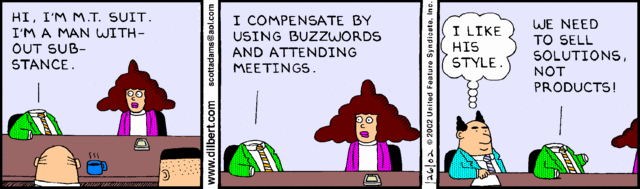
After all, we should all be selling solutions that solve real customer problems, not peddle products!

Tuesday, December 21, 2010

Evaluation Copy of the Software

One of the key "try before you buy" techniques used by product marketers in the software industry is for a qualified prospect to download an evaluation copy of the software. The evaluation copy of the software would typically have a time period (usually a month) associated with it. Another form of trial version is when you want to release a "pre-production" version of your software for testing purpose to a select few customers. In this post, I will be talking about the first case. You already have general availability(GA) release of your software. You are making your software available to a prospect for evaluation purpose.

Some of the key questions to consider:

Monday, November 22, 2010

Dual role of Product Manager and Product Marketing Manager

Can and should the same person be responsible for both product management and product marketing for a product?

Couple of years ago, I was faced with that decision while leading a team of product managers. The open headcount I had for the Product Marketing Manager got frozen because of the ensuing financial crisis and lack of visibility. 

Monday, November 15, 2010

Analyzing Your Presentations

"According to most studies, people's number one fear is public speaking. Number two is death. Death is number two. Does that sound right? That means to the average person, if you go to a funeral, you are better off in the casket than doing the eulogy"
- Jerry Sienfeld

Making effective presentation. A very important skill for a Product Manager/Product Marketing Manager.

While the content of a presentation is extremely important, how you deliver is equally, if not, more important (more about that later in this post). Mastering the behavioral aspects of effective presentation takes time and a lot of practice.

Saturday, November 13, 2010

Feature Request from an Important Customer


"It is not the employer who pays the wages. Employers only handle the money. It is the customer who payes the wages".
- Henry Ford

If you are in the product management role in an enterprise software company, you have probably come across the following situation at least once.


You and your team are working feverishly towards the finish line of a release. Suddenly there is an escalation from the sales channel. One of your important customers is making a feature request that needs to be addressed quickly. The big sale to another department in that customer may not come to pass. Or, the customer may not renew the Enterprise License Agreement that’s coming up in a few months. Unless, of course, you promise to add the feature the in the next release or worse still, deliver it as an emergency bug fix within the next few weeks!

Wednesday, November 10, 2010

Customer Service Org - a Key Stakeholder

... for a product manager and a product marketer. More often than not though, we, as product managers or marketers do not take a proactive approach in our interactions with this important stakeholder.

As a product manager, you spend quite a bit of time on customer escalations coming through the support channel. With Q/A and support folks, you "triage" customer reported bugs to be put on the list for next hotfix. When it's time to plan for a release you are sure to check on the enhancement request queue that has been piling up.

Monday, November 8, 2010

Financial Analysis ... It Pays to be Proactive

Doing regular financial analysis of your product(s) is an important part of a product manager’s job. With everything else going on around you, it’s hard to do it in a disciplined manner though. In the early part of my product management career, I tended to be more reactive – GM asks for reports about how we did in a certain vertical or in a specific geo in the recently concluded quarter and I would scramble to get the reports out of the sales system. A few years back, I was entrusted with the responsibility of leading a product management team to nurse a product suite back to financial and functional health. Through that experience I learned the power of doing proactive financial analysis and powerful insights you can get through data driven analysis.

So what kind of financial analysis would you do and how frequently should you do it?

Wednesday, November 3, 2010

Of Creams and Dreams ...

One of my favorite quotes is by Charles Revson, founder of Revlon Cosmetics - "In the factory we make cosmetics; in the drugstore we sell hope".

.. very relevant for the product manager role. Depending on the audience you are addressing to, you as a product manager need to communicate at the right level. To the customers and prospects, you are selling the benefits of your product and your company’s brand with the emphasis on how the product helps them solve real world problems. Although in some cases and for some audience (e.g., technical folks in the customer’s organization evaluating your product), you might be required to get into the details of how your product is built (e.g., review the architecture of the product to determine compliance with technical standards in the customer environment), for the most part you want to stick with talking about the benefits of your product and get the customer/prospect excited about how she is going to get the solution to the business problem by using your product. You really need to hammer home the points about customer advantage with your product and why the customer should buy from you.